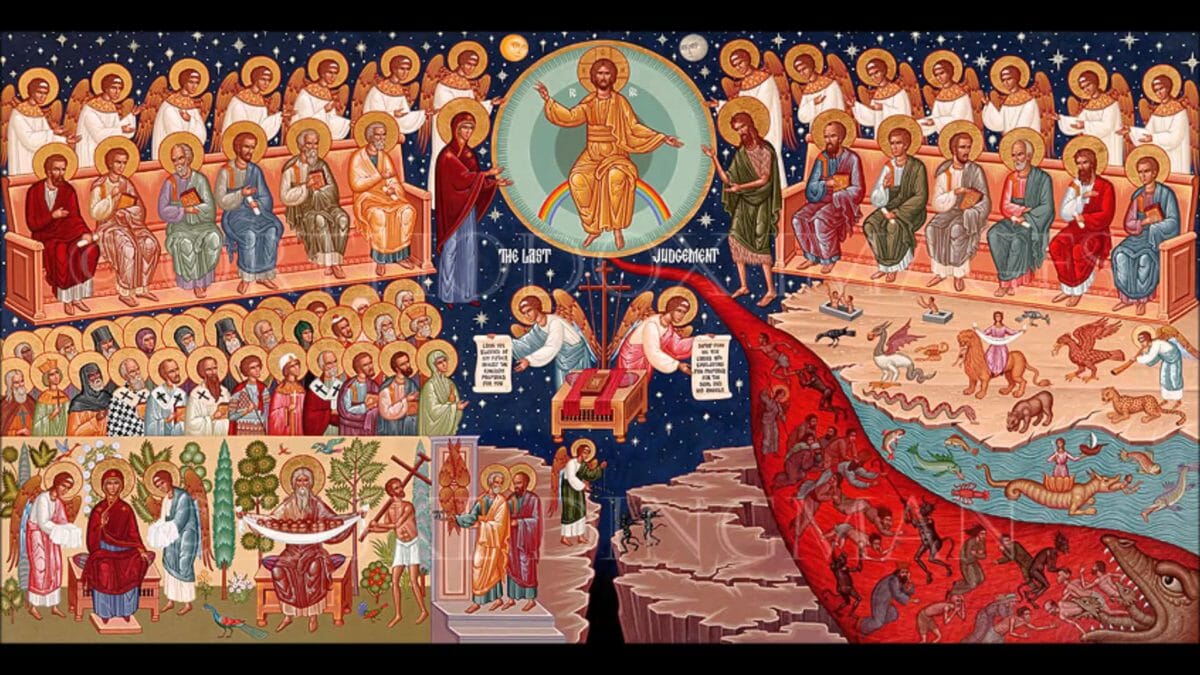
Sunday's homily on the Last Judgment followed a familiar script. Two groups. Sheep and goats. An irreversible verdict. Eternal fire on one side, eternal life on the other. Case closed.
I sat in the pew and listened, as I have listened for years, and I thought: this sermon does not represent the fullness of the Tradition. It represents one strand of it, delivered with the confidence of someone who has never seriously considered the others.
I am not writing to replace one certainty with another. I am writing because the Orthodox tradition on the Last Judgment is richer, more contested, and more hopeful than the version that gets preached from most of our pulpits. The binary framing flattens a conversation that the Fathers themselves refused to close.
The Fathers Did Not Agree
The homily assumed that the meaning of the Last Judgment is settled patristic consensus. It is not.
St. Gregory of Nyssa (the "Father of Fathers"), a Cappadocian Father whose orthodoxy has never been questioned, argued in De Anima et Resurrectione that evil has no independent existence. It is a privation, not a substance. Because evil is a lack, it is inherently finite. God, however, is infinite. Gregory concluded that the infinite must eventually swallow up the finite. He compared the soul to gold mixed with dross: the furnace of judgment does not destroy the gold but separates the impurity from it. Elsewhere, he used the image of a rope encrusted with mud being pulled through a narrow opening. The process is painful because the mud clings to the rope, but the goal is to have the rope emerge clean on the other side. For Gregory, the fire of judgment aims at purification, not permanent torment, and its end is the restoration of all things, when God becomes "all in all" (1 Cor. 15:28).
St. Isaac the Syrian, one of the most widely read ascetical writers in the Orthodox world, refused the retributive framework entirely. For Isaac, the suffering of Gehenna is not the absence of God's love but its overwhelming presence. The "scourge" of Gehenna is love. When a person realizes they have acted against infinite love, the regret is more agonizing than any physical fire. Isaac wrote that it is not the way of the compassionate Creator to create rational beings in order to deliver them over mercilessly to unending affliction. He described God's mercy as a boundless ocean and our sins as a handful of sand thrown into it. The sand cannot stop the ocean. It is simply swallowed up.
Neither of these Fathers denied judgment. Neither denied that the encounter with God will be terrible for those who have hardened against him. What they denied was that the terror is the point, that the fire is an instrument of permanent retribution with no further purpose.
One Fire, Not Two
The homily presented judgment as a courtroom: the righteous are acquitted, the wicked are sentenced, and the sentence is carried out by an external agent of punishment. This image owes more to Western juridical theology than to the Eastern patristic tradition.
Fr. Thomas Hopko, of blessed memory, taught this clearly, echoing the "River of Fire" theology articulated by Alexandre Kalomiros. At the end of the ages, Hopko noted, all will have to behold the face of Christ. For those who love God, that presence will be infinite joy, paradise, and eternal life. For those who hate the Lord, that same presence will be infinite torture, hell, and eternal death. The reality for both the saved and the damned will be exactly the same. The fire is not two different fires. It is one reality, the presence of God, experienced differently according to the disposition of the one who encounters it.
Hopko also emphasized that the judgment is simply the presence of Christ. He pointed to John's Gospel, where Jesus says he did not come to condemn the world but that his very presence constitutes judgment. The light shines in the darkness, and some do not accept it because they love darkness more than light. The judgment is not something God does to us. It is what happens when the full reality of God meets the full reality of who we have become.
St. Maximus the Confessor said the same: the fire "which proceeds before the face of the Lord" is the energies of God. These energies enlighten those who are like them and burn those who oppose them.
Archbishop Alexander (Golitzin), a patristics scholar whose work on Dionysius the Areopagite and the Syriac mystical tradition has earned him wide respect, has stated the point without hedging: God does not exact retribution. God simply is God. His love and light are experienced as a fire of torment by those who seek to close themselves off from it. The suffering is real, but the source of the suffering is not divine wrath. It is the collision between an unchanged God and an unchanged sinner. For Golitzin, the obsession with 'who goes where' can be a distraction from the more fundamental question: are we learning to open ourselves to God's love? He reminds us that while the Church knows who is in heaven, she has never dogmatically defined who, if anyone, must remain in hell forever.
This raises a question the binary homily never asks. If the fire is God himself, and if God is love, and if love by its nature seeks the restoration of the beloved, what is the fire for?
The Regenerating Fire
Fr. Sergius Bulgakov offered one answer. In The Bride of the Lamb, he argued that the torments of Gehenna contain regenerating power. The suffering is not imposed from outside as juridical punishment. It is an inwardly, synergistically accepted spiritual state. Bulgakov described Gehenna as a kind of purgative condition, perceived not as a retributive sentence but as an effect of God's justice revealed in its inner persuasiveness.
Bulgakov's most striking claim was this: "A human being cannot fail to love the Christ who is revealed in him, and he cannot fail to love himself revealed in Christ." To see Christ at the eschaton is to recognize the fulfillment of your own deepest nature. The pain of Gehenna is the pain of the distance between what you have made of yourself and what Christ reveals you were made to be. That pain is real. But it has a direction.
Bulgakov also made an observation that deserves wider attention. The Church, he noted, has not established a single universally obligatory dogmatic definition in the domain of eschatology beyond the resurrection and the return of Christ. The confident dogmatism of the Sunday homily, the certainty that the binary is the whole story, goes beyond what the Church has formally defined.
Dare We Hope?
Metropolitan Kallistos Ware addressed the question head-on in his essay "Dare We Hope for the Salvation of All?" He held two principles in tension: God's love is unconditional, and human freedom is real. His conclusion was measured: if the strongest argument in favor of universal salvation is the appeal to divine love, and the strongest argument on the opposite side is the appeal to human freedom, then we cannot do more than hold fast with equal firmness to both principles at once, while admitting that the manner of their ultimate harmonization remains a mystery beyond our present comprehension.
Our belief in human freedom means we have no right to categorically affirm "all must be saved." But our faith in God's love makes us dare to hope that all will be saved.
Ware ended the essay by quoting St. Silouan of Mount Athos: "Love could not bear that." Love could not bear the eternal loss of a single soul.
Silouan deserves more than a closing quotation. He is a canonized saint of the Ecumenical Patriarchate, glorified in 1987, and his teaching on this subject is among the most radical in modern Orthodox sanctity. Silouan taught that the Christian is called to pray for the whole world with the same love with which Christ prayed on the cross. Not for the righteous only. Not for the baptized only. For the whole world, including the dead, including those who have rejected God, including, in his most challenging formulation, the demons themselves. He wept over the damnation of others not as a sentimental exercise but as a participation in the mind of Christ, who desires that none should perish.
If the binary homily is correct, if the verdict is final and the fire is permanent and there is nothing more to say, then Silouan's tears are wasted. His prayer for the damned is an exercise in futility directed at a God who has already closed the account. But the Church canonized Silouan. It held up his prayer as a model, not an error. That fact alone should give the confident binary preacher pause.
The proper posture, for Ware and for Silouan, is not certainty in either direction. It is prayer with tears for the salvation of all, combined with the refusal to presume.
This is a very different posture from the binary homily, which presumes a great deal.
Pascha and Its Scope
Fr. Alexander Schmemann, perhaps the most influential Orthodox liturgical theologian of the twentieth century, did not write systematic eschatology in the way Bulgakov did. But his entire theological project was built on the conviction that Christ's victory over death is total and cosmic.
Consider what we sing at Pascha. "Christ is risen from the dead, trampling down death by death, and upon those in the tombs bestowing life." The troparion does not say "upon some in the tombs." It does not qualify. It does not limit. The Paschal icon shows Christ pulling Adam and Eve from the grave, the gates of Hades smashed beneath his feet. The image is not of a partial rescue. It is of a comprehensive victory.
Schmemann's For the Life of the World is animated by the conviction that the Eucharist is offered for the life of the whole world, not a fraction of it. The liturgical theology of the Church, when taken seriously, complicates the neat binary of the Sunday homily. If death is truly defeated, if Hades is truly emptied, then we have to ask what that means for those who are still, in the language of the tradition, "in the tombs."
Fr. John Behr, writing and teaching from within the heart of the patristic tradition, has increasingly pressed this point. His scholarly work on Origen and Gregory of Nyssa has consistently drawn attention to the restorative dimensions of early Christian eschatology that the binary framing suppresses. His endorsement of recent theological work on universal restoration was direct: he described it as a treatment of "the promise that, in the end, all will indeed be saved, and exposing the inadequacy, above all moral, of claims to the contrary."
What the Homily Got Wrong
I do not fault yesterday's homilist for preaching repentance. The Sunday of the Last Judgment exists in the liturgical calendar to shake us awake before Great Lent. The sheep-and-goats parable is meant to terrify, and it should. The prospect of standing before Christ and having to account for every act of mercy we refused to give is properly sobering.
What I fault is the closure. The insistence that this is the whole picture. That the tradition speaks with one voice. That the fire has no purpose beyond punishment. That the binary is permanent, absolute, and dogmatically settled.
It is not settled. Bulgakov said so. Ware said so. The Fathers themselves said so by disagreeing with each other.
Gregory of Nyssa looked at the fire and saw a refiner's furnace. Isaac the Syrian looked at it and saw the overwhelming weight of rejected love. Hopko looked at it and saw the single, undivided presence of God, experienced as paradise by some and as torment by others. Bulgakov looked at it and saw a purgative process with regenerating power. Schmemann looked at the Paschal icon and saw Hades emptied.
None of them denied the seriousness of judgment. All of them refused to make it the final word.
The gates of the New Jerusalem, as the last book of Scripture tells us, will never be shut.
For Further Reading
- St. Gregory of Nyssa, De Anima et Resurrectione
- St. Isaac the Syrian, The Ascetical Homilies
- Alexandre Kalomiros, The River of Fire (1980)
- Metropolitan Kallistos Ware, "Dare We Hope for the Salvation of All?" in The Inner Kingdom (SVS Press, 2001)
- Sergius Bulgakov, The Bride of the Lamb (Eerdmans, 2002)
- Alexander Schmemann, For the Life of the World (SVS Press)
- Fr. Thomas Hopko, The Orthodox Faith, Vol. 1, and "The Sunday of the Last Judgment" (Ancient Faith Podcasts)
- Fr. John Behr, ed. and trans., Gregory of Nyssa: On the Human Image of God (Oxford, 2023)